No. 1 George: What a week in Greece taught us about money and AI
GROUND TRUTH
By Harrison Floyd, Kelsey Wohleben and Clay Duncan
We went to Athens with the standard American picture of Greece in our heads. The Acropolis, the debt crisis, and very good islands. We came back having watched a government of ten and a half million people do the thing we had been failing to do inside our own company, and having heard a Greek software executive describe, out loud, the product we were trying to build before we had the words for it.
This is the long version of where George came from.
The question that became George
It came up in a conference room at EnterSoftOne, a company that exists because two Greek enterprise software firms spent twenty five years trying to kill each other and then merged anyway. Their head of AI was walking us through what they had built for their customers, and he gave an example. A business owner asks: should I take a one million euro loan to expand to Thessaloniki?
The system does not search the web for advice about expansion. It opens that company's actual books, reads their actual cash flow, compares them against their actual competitors, and returns a reasoned answer with the numbers attached.
It was a good demo. What we could not stop talking about on the way out was that a small business in Athens can now ask a machine whether it can afford to grow, and almost no ordinary person can ask that about their own life. A household with a mortgage, two kids, a car payment and a nagging sense that something is off gets a budgeting app that color codes what already happened to them. Nobody is answering the actual question, which is always some version of: can I do this thing, and what does it cost me later?
George is our answer to that question. The rest of this entry is the five things that week taught us about how to build it.
Harrison Floyd, Founder and Chief Strategy Officer: "I had spent months trying to explain what I wanted this thing to do. A guy in Athens explained it to me in one sentence about a loan."
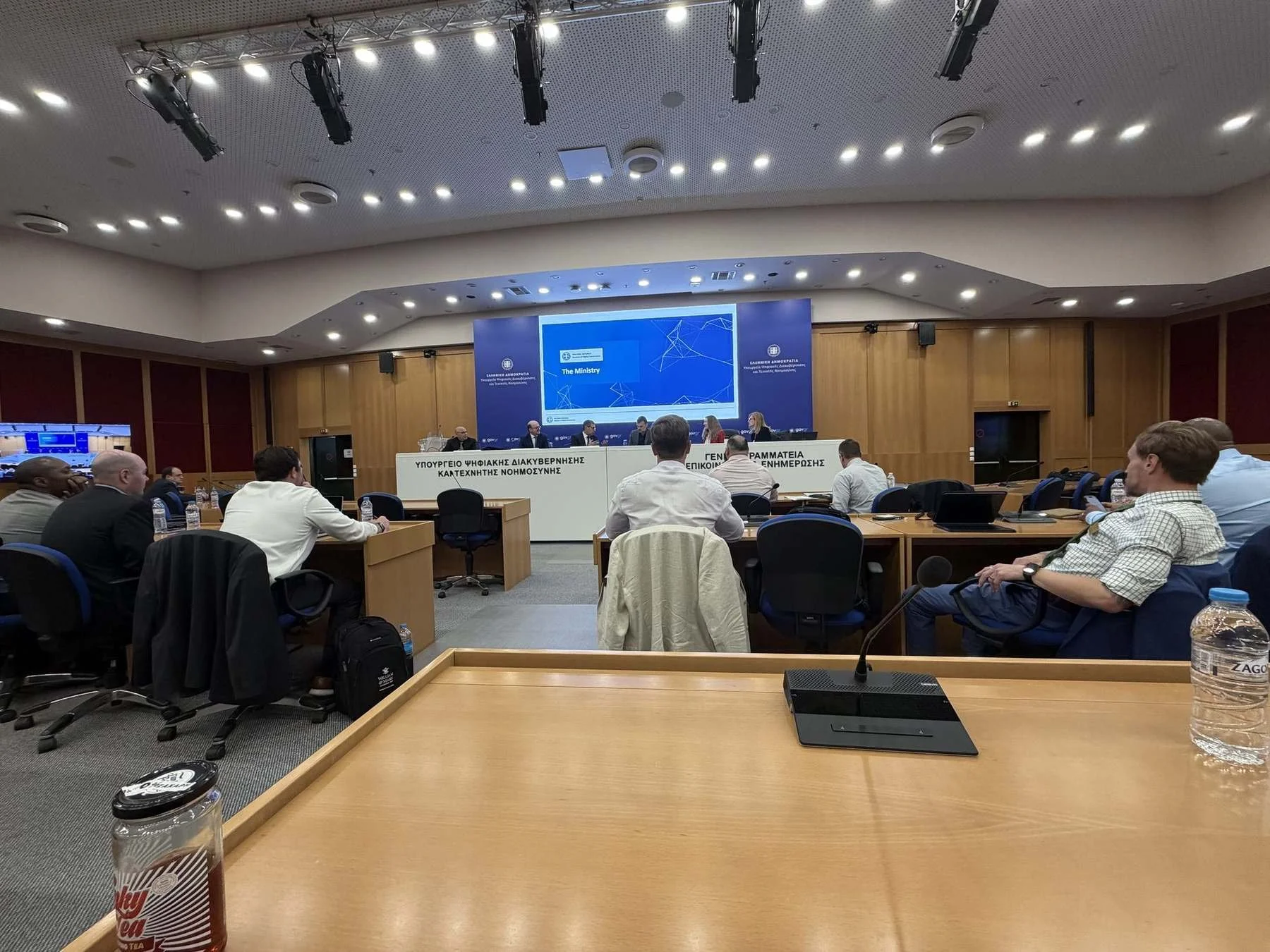
The Ministry of Digital Governance and Artificial Intelligence, Athens.
1. Data matters more than AI
The most useful sentence of the week came from the Special Secretary for AI and Data Governance at Greece's Ministry of Digital Governance. Data, he said, is more important than AI. You can have data without AI. You cannot have AI without data.
That is obvious the moment somebody says it and almost nobody builds like they believe it. The entire consumer AI market right now is a race to wrap the same handful of frontier models in a nicer interface. The model is the commodity. What is not commodity is whether the thing has any real knowledge of you, and whether that knowledge survives.
He was also refreshingly blunt about where Greece stands. He cited a ranking that put the country twenty seventh out of thirty eight on AI readiness and made no attempt to spin it. His pitch was not that Greece would build a frontier lab. It was that Greece would be the safe, regulated, sovereign infrastructure layer for southeastern Europe. Know what you are, build the layer you can actually own.
We took that literally. George runs on frontier models and we do not pretend otherwise. What CivicForge owns is the layer underneath: your financial memory, the record of what you asked, what changed, what you decided, and what happened next. Models will get better and we will swap them. The memory is the asset, and it belongs to you and to us, not to whichever vendor is winning this quarter.
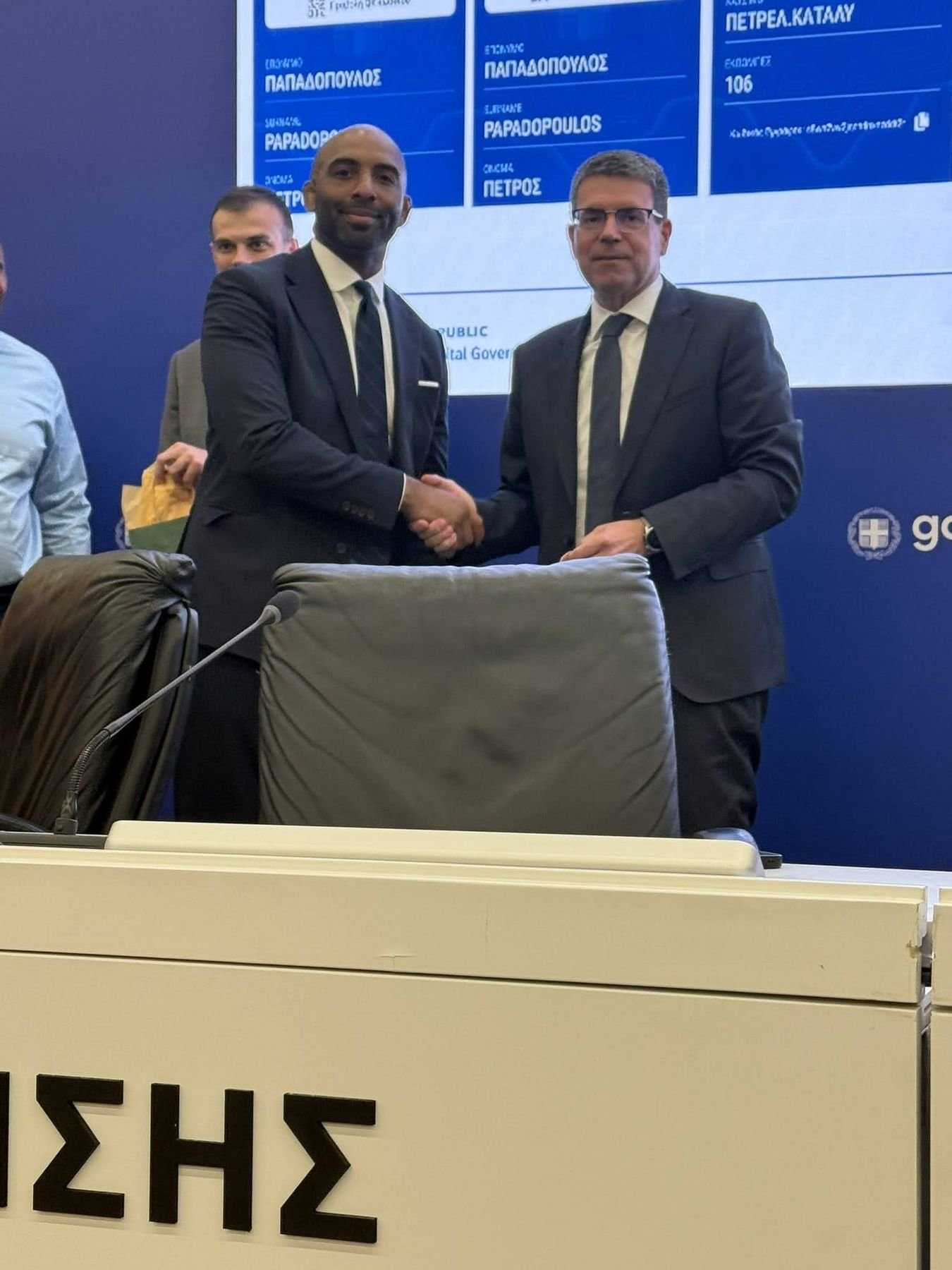
The government portal on screen during the ministry briefing.
2. Consolidation beats coordination
In 2019 Greece ranked twenty sixth out of twenty eight EU member states on the European Commission's digital economy index, scoring 25.5, down with Romania and Bulgaria at the bottom of the table. The response was not a coordination committee. The government pulled every tech-adjacent agency into a single ministry, built one portal for government services, issued shared login credentials, and passed legislation requiring agencies to share data with each other for defined purposes.
The result is not subtle. In the 2025 OECD Digital Government Index, Greece scored 0.71 against an OECD average of 0.70, ahead of average on user-driven design (0.77), government as a platform (0.75) and proactiveness (0.70). That single portal now carries more than 2,100 services covering about 100 life events. And 9.3 million citizens hold one personal identification number for their dealings with the state, against a resident population of 10,372,335 on 1 January 2025. Roughly nine in ten people.
The word we kept coming back to on the bus was consolidation. Not integration, not alignment, not any of the words that mean four systems agreeing to talk. One system, by law.
That is the argument for the CivicForge Dashboard. The reason personal software is exhausting is not that any one tool is bad. It is that your money lives in one place, your calendar in another, your documents in a third, and each of them asks you to be the integration layer. Our models sit in one place and draw on one shared memory, because a person should not have to be the interoperability backbone of their own life.
Kelsey Wohleben, Co-Founder and Chief Executive Officer: "A country did in five years what most companies cannot do to three departments. It works because it is small enough to just decide. So are we."

A briefing on the Greek economy at the Bank of Greece.
3. Consent, not uploads
Here is the part that changed a specific design decision.
Under the Greek model, a citizen going to a government appointment does not bring documents. They grant permission, and the state fetches the record from whichever agency already holds it. By the ministry's account, more than twenty five million transactions have run through that interoperability layer. Greece wrote the European "once-only" principle into national law in May 2026, and the responsible minister was explicit that it is not a database storing personal data; it is a permissioned exchange. The wallet on people's phones is the visible end of it: 2,516,405 digital identity cards and 1,984,991 digital driving licences issued as of July 2026.
The citizen is not the courier. That is the whole idea, and it is a customer experience decision disguised as public administration.
Every personal finance product we had ever used made us the courier. Download the statement, export the CSV, categorize the transaction, correct the categorization. George does not. You grant access once through Plaid, a bank-grade connection, George reads what you allowed and nothing else, and the permission is yours to withdraw.
4. Measure the click, not the launch
Metlen is a Greek industrial group doing metals, energy and infrastructure, which is hard to summarize and harder to run one software strategy across. Their digital transformation lead asked the room what share of digital transformations succeed. Guesses ranged from five percent to thirty.
Then he told us how he avoids the failing group. He does not measure whether a tool went live. He measures whether people open it and click the button, every day. If they do not, the tool is not delivering value, and the fact that it shipped on schedule is irrelevant.
We have built things that launched and died. Everyone has. What made this land is that he had turned it into an operating rule rather than a lesson learned.
It is a brutal standard for a personal finance product, because the honest truth about that category is that engagement collapses around week three. People do not want to open a finance model every day. They want to not think about money and be told when thinking about money is required.
So George does not compete for a daily open. George watches for drift against the goal you set and reaches you with one short prompt at the moment a spending decision is being made, then goes quiet. A finance tool you have to remember to open is a finance tool you quit. We designed around that rather than hoping our version would be the exception.
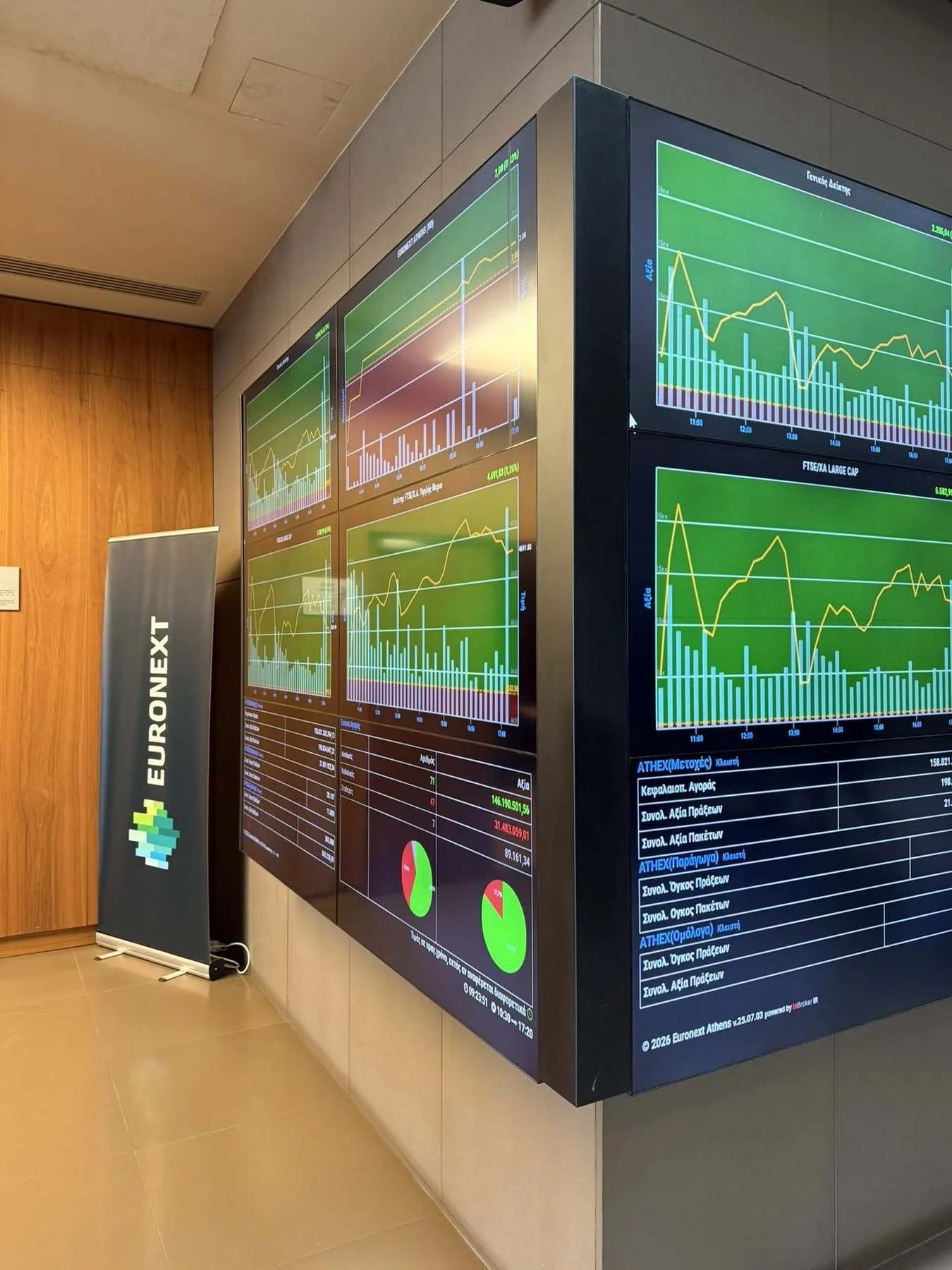
The market data wall at Euronext Athens.
5. Compliance is a design tool, not a tax
Back at EnterSoftOne, one detail stuck harder than the demo. They classify every AI feature they ship against the EU AI Act's risk categories and maintain a registry of them.
We had been thinking about the AI Act the way most American builders do, as a compliance headache arriving from Brussels on someone else's schedule. Watching a company treat it as a forcing function was a real reframe. If you have to state, in writing, what each feature does, what data it touches, and what happens when it is wrong, you end up building something better. Not because a regulator made you. Because you had to say it out loud.
CivicForge handles equity data and legal data. Pro Se and the Equity Engine are not products where "we'll figure out governance later" is survivable. We now keep a feature register on the same principle, and George was the first model built under it. It is why George's limits are published on its own page rather than buried in terms: no investment, securities, wealth, tax or legal advice, no moving your money, no shaming and no surveillance. Those are not disclaimers written afterward. They are risk classifications we decided first and then had to live with.

Lunch beside the canal, Athens.
What we did not expect
What we did not plan for was how much of the week was not about business.
We started at the Acropolis, which is difficult to be cynical about, and walked down to the Agora, the first organized marketplace. The Greeks did not separate the market from the politics from the just hanging around. It all happened in the same square. A few days later we drove south along the coast to the Temple of Poseidon, which ancient sailors used as both a shrine and a navigation marker, and that drive did more to explain Greek commerce than any slide we saw all week.
We toured Piraeus, one of Europe's largest container terminals, operated under a long-term concession by COSCO. We visited Apivita, a cosmetics company founded in 1979 by two pharmacists who were serious about bees, which by its own account has regenerated more than five billion of them against an original target of one billion. Their presenter said something we are still chewing on: if companies were invoiced by nature for the ecosystem services they consume, none of them would be profitable.
And in almost every room, the same pattern. A crisis had made the hard thing possible. The ministry did its consolidation right after an election, when it had the leverage. The fund's owner told the leadership team on day one that 95 percent of mergers fail, then came back a year later and said he had been wrong about this one. Metlen restructured after losses. OTE was overhauled at the worst moment in the country's modern financial history, and the public record shows the price: a 2011 union agreement cut pay by 12, 11 and 10 percent across 2012 to 2014 and moved roughly 2,000 employees into voluntary retirement, with no involuntary layoffs. Nobody said the crisis was good. Several said it was the only reason the organization stopped being able to choose the comfortable option.
Clay Duncan, Co-Founder and Chief Financial Officer: "Every leader we met had a moment where doing nothing stopped being available. That is when the real work started."
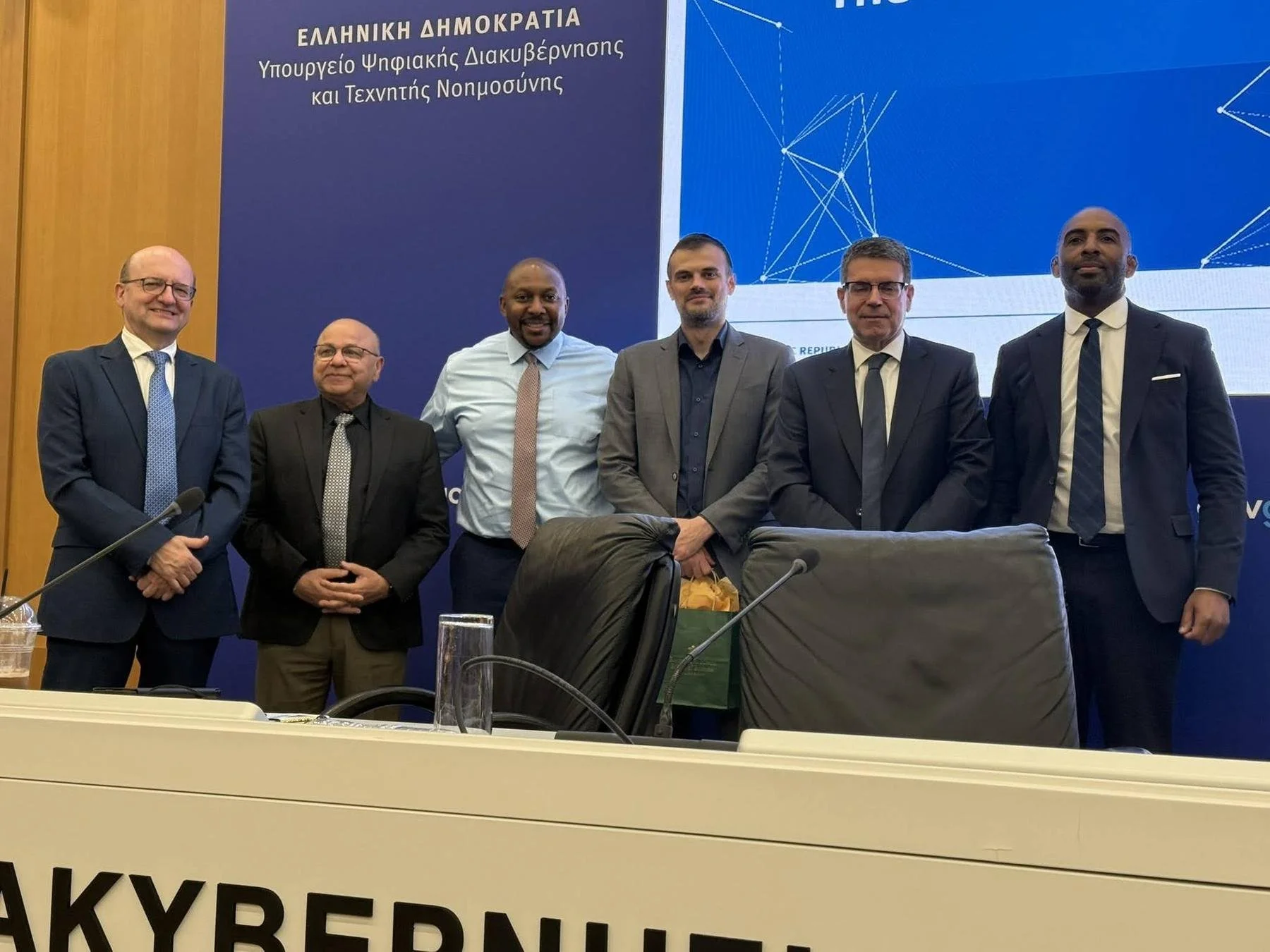
The delegation with officials at the Ministry of Digital Governance and Artificial Intelligence.
So we built George
George is a behavioral finance coach, and it launches this month.
You connect your accounts through Plaid, once. You tell George one specific thing you are trying to do: not "spend less," which is a wish, but something narrow enough to actually keep. From then on George works from your real transaction data rather than from general advice, and it comes to you rather than waiting to be opened. When your spending drifts from the goal you set, George sends one short, nonjudgmental message that offers a choice. You decide. George logs the outcome and learns your rhythm.
The five decisions behind it all trace back to that week:
The memory layer belongs to CivicForge and to you, not to a model vendor, because data outlives models.
One dashboard, one identity, one shared memory across every model, because you should not have to be your own integration layer.
Consent and fetch, never upload, because you are not the courier.
Delivery at the moment of decision, because the metric is whether it gets used, not whether it shipped.
A feature register from day one, because this is money and it should be built like it.
We should be straight about what George is not, yet. George does not answer the million euro question from that conference room. It will not tell you whether you can afford the house, and it gives no investment, securities, tax or legal advice. The evidence we started from, two randomized controlled trials reported in Terblanche, Molyn, De Haan and Nilsson (2022), tested coaching toward personal goals, not affordability modeling. Starting narrow and earning the next step is the method, not an apology.
A Greek business owner can ask a machine whether they can afford to grow. We did not see a reason a family in Virginia should not eventually be able to ask the same question. George is the first step toward that, and everything above is why it is shaped the way it is.
See what George does, and what it will never do
What is next
Ground Truth No. 02 is about Flow, and about what the research actually says on how people with complicated lives keep a schedule, including the line we liked that the evidence made us delete.